In the early 1800s, if you wanted to send a barrel of flour from Buffalo to New York City, you had two bad options. You could haul it hundreds of miles over rutted roads by wagon, slowly and at enormous cost. Or you could send it the long way round, through the Great Lakes and the St. Lawrence, through British Canada. The interior of the young country was effectively cut off from its east coast by the Appalachian Mountains. A few people had a crazy idea: what if you dug a river?
A gamble called "Clinton's Ditch"
The idea of a canal from the Hudson River to Lake Erie had been floating around for years. The federal government refused to pay for it. President Jefferson reportedly called the idea "little short of madness." So New York State decided to go it alone, pushed hard by DeWitt Clinton, former mayor of New York City and soon to be governor.
Critics mocked the project as "Clinton's Ditch" and "Clinton's Folly." The numbers were frightening: around 363 miles of canal through forests, swamps and rock, with a climb of more than 500 feet from the Hudson to Lake Erie. The state borrowed heavily to pay for it.
Engineers who learned on the job
The United States had almost no trained civil engineers in 1817. The men who led the work, including Benjamin Wright and James Geddes, were surveyors and judges who taught themselves as they went. The canal became, in effect, America's first school of engineering. One of the crew, Canvass White, travelled to Britain to study canals and came back to develop a hydraulic cement, using local limestone, that would set underwater, crucial for building locks.
Work began at Rome, New York, on July 4, 1817. Thousands of labourers dug it, many of them local farmers, with growing numbers of Irish immigrants as the work went on. They used shovels, picks, horses and clever inventions like stump-pulling machines. Swamps near Syracuse brought outbreaks of disease. Progress was measured mile by painful mile.
America's first great engineering school didn't have classrooms. It had a 363-mile trench.
The Flight of Five
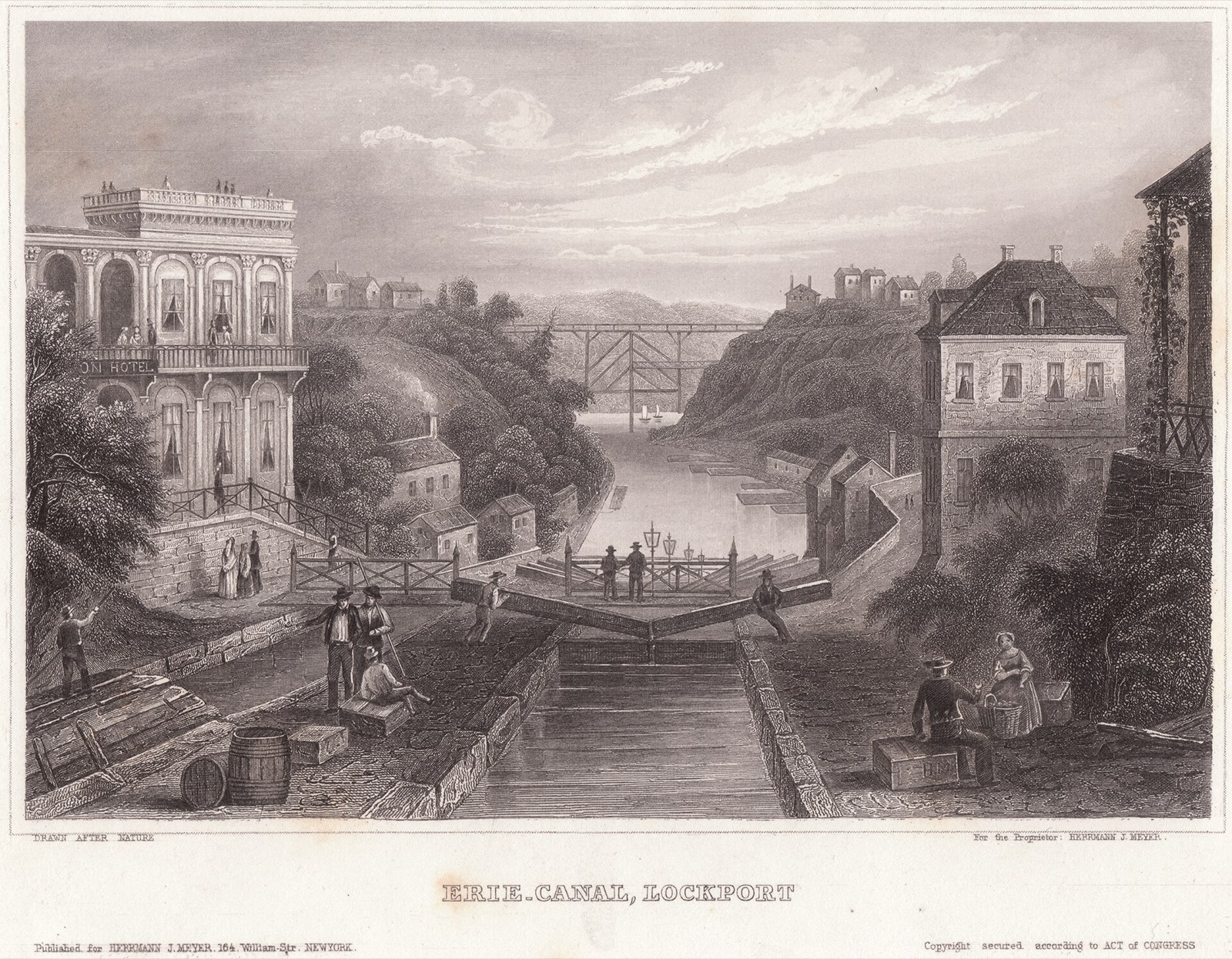
The hardest part was the Niagara Escarpment near what became the town of Lockport. Engineers built a double staircase of five locks, side by side, one set for boats going up and one for boats going down, lifting vessels about 60 feet up the rock face. The "Flight of Five" was a marvel, and visitors came from far away to watch boats climb it. Parts of it can still be seen today.
The Wedding of the Waters
On October 26, 1825, the canal opened. Governor Clinton boarded the canal boat Seneca Chief at Buffalo. As the boat set off, cannons placed along the route fired one after another, relaying the news all the way to New York City and back in a matter of hours, a sort of artillery telegraph.
The flotilla travelled across the state, down the Hudson and into New York Harbor, arriving in early November to enormous celebrations. Off Sandy Hook, Clinton poured a keg of Lake Erie water into the Atlantic Ocean. The ceremony was called the "Wedding of the Waters." The city held parades, fireworks and banquets.
How a ditch built a city
The canal was an immediate success. The cost of shipping goods between Buffalo and New York City fell dramatically, by around ninety percent by many estimates, and journey times shrank from weeks to days. Tolls repaid the state's debt within about a decade.
The effects were enormous:
- New York City became the gateway between Europe and the American interior, overtaking Philadelphia, Boston and Baltimore to become the nation's busiest port and its financial capital.
- Upstate towns like Syracuse, Rochester, Utica and Buffalo boomed along the route.
- The Midwest filled with settlers and farms, and its grain flowed east.
- Ideas travelled too. The canal corridor became a hotbed of religious revivals and reform movements, including abolition and women's rights. It's sometimes called the "Burned-over District." Seneca Falls, home of the 1848 women's rights convention, sits near the canal system.
The "Empire State" nickname predates the canal, but the canal made it ring true.
Mules, songs and a long afterlife
Canal boats were pulled by mules and horses walking along a towpath. The low bridges over the canal forced passengers on deck to duck, which inspired the 1905 song "Low Bridge, Everybody Down," better known as "Fifteen Miles on the Erie Canal." The canal was enlarged several times in the nineteenth century, and in 1918 most of it was replaced by the wider New York State Barge Canal. Railroads eventually took most of the freight.
Today the canal is used mainly for recreation, by kayakers, cyclists on the Empire State Trail and leisure boats. In 2025 New York marked the canal's bicentennial with events along the whole route. There's more in our news.