The Declaration of Independence says that all men are created equal. When it was written, about one in five people in the colonies was enslaved, women couldn't vote, and Native nations were treated as obstacles. The story of American civilisation is, in large part, the story of people who took those founding words more seriously than the founders did, and spent generations forcing the country to live up to them. This chapter follows a few milestones on that long road. It's not the whole story. No single chapter could be.
Seneca Falls, 1848
In July 1848, about three hundred people gathered at a chapel in Seneca Falls, New York, a small mill town in the canal country we described in Chapter 6. The organisers included Elizabeth Cady Stanton and Lucretia Mott. Stanton wrote a "Declaration of Sentiments," deliberately modelled on the Declaration of Independence, stating that "all men and women are created equal."
The most controversial resolution demanded the right to vote. Even some supporters thought it went too far. It passed after the abolitionist Frederick Douglass, who had escaped slavery and become one of the most powerful speakers in the country, rose to support it. One hundred people, sixty-eight women and thirty-two men, signed the declaration.
War, freedom and Reconstruction
Slavery was the country's deepest contradiction, and it took a civil war that killed hundreds of thousands to end it. The Emancipation Proclamation of January 1, 1863 declared enslaved people in Confederate-held territory free. Three constitutional amendments followed the war:
- 13th Amendment (1865) abolished slavery, except as punishment for a crime.
- 14th Amendment (1868) guaranteed citizenship to everyone born in the US and promised "equal protection of the laws."
- 15th Amendment (1870) barred denying the vote on the basis of race.
During Reconstruction, Black Americans voted in large numbers, and hundreds were elected to office, including the first Black members of Congress. But after federal troops withdrew from the South in 1877, white supremacist governments rolled back those gains through violence, poll taxes, literacy tests and segregation laws known as Jim Crow. The promises were in the Constitution, but for nearly a century many were not enforced.
The amendments were written in the 1860s. For millions of Americans, they came into force in the 1960s.
Votes for women
The women's suffrage movement took seventy-two years to win the vote nationally after Seneca Falls. Campaigners like Susan B. Anthony, Ida B. Wells and Alice Paul organised petitions, parades, pickets outside the White House and hunger strikes. The 19th Amendment, barring denial of the vote on account of sex, was ratified in August 1920. Many women of colour, especially in the South, still faced barriers to voting for decades afterwards.
Harlem, New York
In the early twentieth century, millions of Black Americans left the South in the Great Migration, and Harlem became the cultural capital of Black America. The NAACP had been founded in New York in 1909. In the 1920s and 30s came the Harlem Renaissance: writers like Langston Hughes, Zora Neale Hurston and Claude McKay; musicians like Duke Ellington; artists, scholars and activists. They argued, through art and argument, that Black culture was central to American culture. The Apollo Theater's amateur nights, starting in the 1930s, launched careers for decades.
The civil rights movement
The legal and moral campaign against segregation gathered force after the Second World War. Key moments include:
- 1954: In Brown v. Board of Education, the Supreme Court ruled school segregation unconstitutional.
- 1955–56: The Montgomery bus boycott, sparked by Rosa Parks's arrest, lasted more than a year and brought Martin Luther King Jr. to national attention.
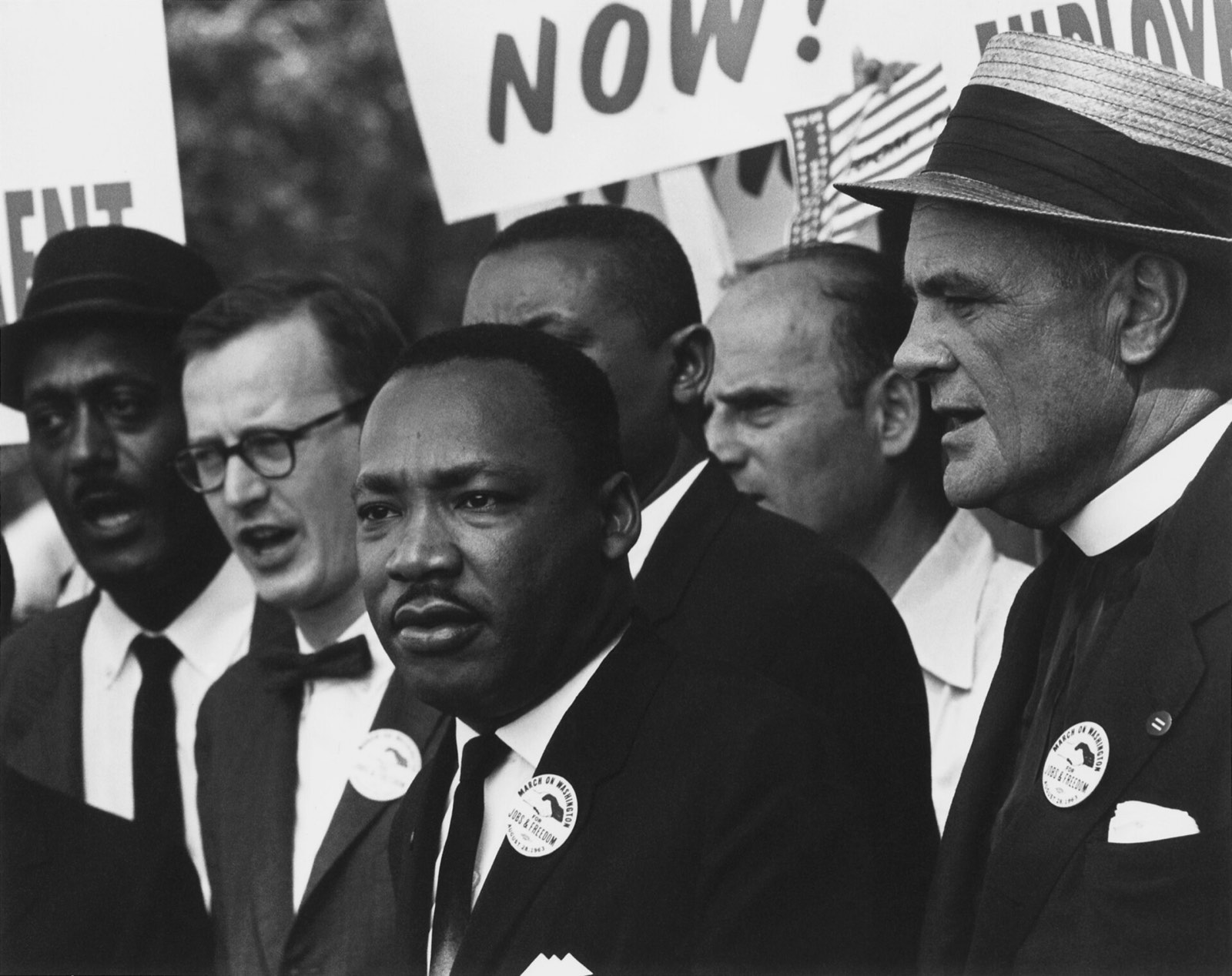
- 28 August 1963: The March on Washington for Jobs and Freedom, organised largely by A. Philip Randolph and Bayard Rustin, both based in New York, drew about 250,000 people. King delivered his "I Have a Dream" speech at the Lincoln Memorial.
- 1964: The Civil Rights Act outlawed discrimination in public accommodations and employment.
- 1965: After the violent attack on marchers at Selma, Alabama, the Voting Rights Act finally put federal power behind the 15th Amendment.
The same year, the Immigration and Nationality Act ended the national-origin quotas of the 1920s (see Chapter 7), transforming the face of cities like New York.
More doors opened
The road kept branching. Native Americans were recognised as citizens by law in 1924, and fought later for sovereignty and treaty rights. Chinese Americans saw the Chinese Exclusion Act repealed in 1943. Disability rights activists won the Americans with Disabilities Act in 1990. In June 1969, patrons of the Stonewall Inn in Greenwich Village fought back against a police raid, an uprising widely seen as a turning point for the gay rights movement. The Stonewall National Monument now marks the site.
An unfinished journey
We end our eight chapters here, but not because the journey is over. From mound cities on the Mississippi to the Great Hall at Ellis Island and the steps of the Lincoln Memorial, the story of American civilisation has always been about people insisting on their place in it. Arguments about who belongs and what equality means are still going on, in courtrooms, in Congress and on New York sidewalks. That's not a flaw in the story. It's the story.